
Table of Contents
Introduction
Picture this: you’re a practice manager, and it’s Thursday afternoon. You’ve got a folder of compliance reports on your desk — every box checked, every number where it’s supposed to be. Technically, you’re clean. A regulator would look at this and move on.
But you know better. You know Dr. Chen covered two extra call shifts last month that never made it into the system. You know the orthopedics department has been logging hours the same way they have since 2017, and nobody’s updated the process. The reports say everything is fine. Your gut says otherwise.
That gap — between what the paperwork shows and what people actually do — is where physician compensation management gets messy. Reports measure outputs. People create chaos, cover for each other, forget to log things, & work in patterns that no template was built to capture. The real risk lives in the space between those two realities.
Physicians Aren't Data Points
Most weeks for a physician won’t fit neatly into categories. One Tuesday, Dr. Patel spends three hours on care coordination calls that don’t generate a single billable code. Wednesday, she covers an unplanned overnight shift because a colleague had a family emergency. Thursday, she sits in two administrative meetings, reviews a quality improvement protocol, & responds to a dozen patient messages through the portal.
Physician compensation management software that treats doctors like data points will miss most of what they actually do. wRVUs capture procedure volume. They don’t capture the orthopedic surgeon who spent Friday afternoon training residents, or the cardiologist who took six after-hours calls that nobody tracked because the on-call log is still a shared spreadsheet someone made in 2019.
The physicians who hold health systems together often do their heaviest work in the margins — the coverage gaps, the committee work, the coordination nobody formally assigned. Compensation software solutions that can’t account for that kind of work leave contracts exposed & physicians frustrated.
You need a system that reflects how doctors work in real life. Not how an analyst assumed they would when the contract template was written.
Where Human Error Gets Expensive
On-call management is chaotic by nature. Physicians rotate, schedules shift last minute, & someone always forgets to log the Saturday night they covered for a colleague. Multiply that across a department of twelve doctors and three months of rolling schedules, and you’ve got a documentation mess that no one created on purpose.
Manual timekeeping doesn’t fail because people are careless. It fails because people are busy. A surgeon finishing a long case at 11pm is not thinking about logging hours. A hospitalist picking up an extra shift is focused on the patient, not the paperwork. These are normal human behaviors, and they create real financial exposure.
The cost runs in two directions. Undocumented work leads to underpayments, which frustrates physicians and strains retention. Poorly tracked work leads to overpayments, which draws regulatory attention and puts the health system in a difficult position with auditors. Both outcomes are avoidable.
Good compensation software solutions work as a protection layer. The goal isn’t to monitor physicians more closely. The goal is to catch the gaps before they become problems — before a routine audit turns into a compliance conversation.
A well-built system holds the line between your organization and that kind of scrutiny. Your physicians stay focused on care. The documentation takes care of itself.
What "Built Around People" Actually Looks Like
The phrase “user-friendly software” gets thrown around a lot. In healthcare, it has a specific meaning: a physician should be able to log time, document activities, & confirm contract compliance in the same amount of time it takes to pour a cup of coffee. If the process takes longer than that, adoption drops and the documentation gaps come back.
Physicians aren’t sitting at desks. They’re moving between floors, between facilities, between patients. Compensation software solutions that require desktop access at the end of a twelve-hour shift will get ignored. The ones that live in a physician’s pocket get used.
Real-time visibility changes the dynamic for administrators too. Instead of discovering a documentation problem at the end of the quarter, you see it the week it happens. Automated FMV checks run in the background, flagging arrangements that drift outside compliant ranges before they become audit findings. Contract adjudication happens as work gets logged, not weeks later when memories have faded.
The whole point is that compliance becomes a byproduct of normal workflow. Physicians do their jobs. The system captures it accurately. Nobody has to circle back, chase down signatures, or reconstruct what happened three months ago from a shared calendar.
The Compliance Shield
Regulators don’t give partial credit. An audit doesn’t care that your documentation gaps were accidental, or that your on-call log was a spreadsheet someone built years ago and nobody thought to replace. By the time scrutiny arrives, the window for fixing things has closed.
Dynafios lives between your organization and that moment. The Provider Compensation Platform runs FMV checks continuously, flags contract arrangements that drift out of compliance, & keeps physician timekeeping accurate enough that an auditor finds nothing to question. That’s the goal: not to prepare for scrutiny, but to make scrutiny unremarkable.
Physician practice consulting works the same way. The Dynafios team knows where regulators look and what they look for. That knowledge goes into how the platform is built and how clients use it. Your legal and compliance teams get cleaner documentation. Your physicians get fewer interruptions. Your administrators spend less time reconstructing records from memory.
The best compliance story is a boring one. Nothing unexpected, nothing to explain, nothing to correct after the fact. Dynafios helps health systems get there — and stay there.
Getting to Fewer Surprises
Physician practice consulting and compensation software solve the same problem from two angles. Contracts stay clean. Physicians stay focused on patients. Administrators stop spending Friday afternoons reconstructing what happened three months ago.
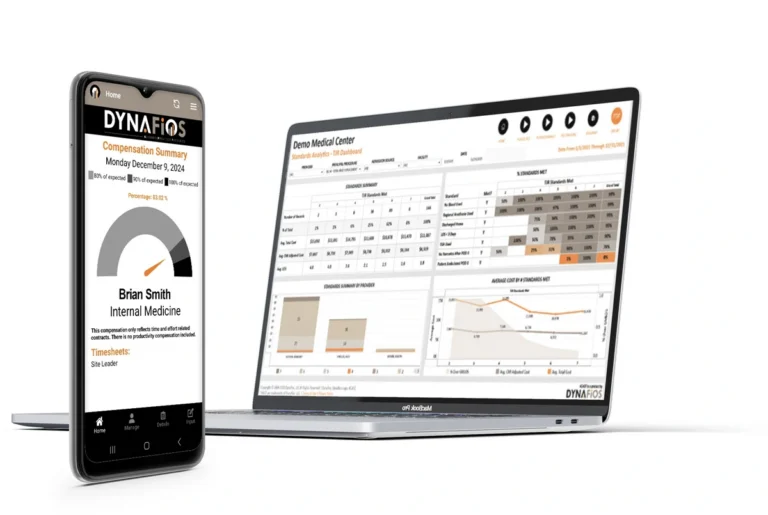
The Dynafios Provider Compensation Platform handles physician timekeeping, FMV compliance, & contract adjudication in one place. It fits around how physicians actually work, catches documentation gaps before they become expensive, & keeps your organization on the right side of regulatory scrutiny.
If the reports on your desk pass but your gut says otherwise, that’s worth paying attention to.
Key Takeaways
- Physician compensation gets messy in the gap between formal reports and the work doctors actually do every day, especially extra call coverage, care coordination, committee work, and last-minute schedule changes.
- Manual logs and shared spreadsheets leave too much room for missed shifts, untracked hours, underpayments, overpayments, and audit risk. Busy physicians are focused on patient care, not paperwork.
- Compensation software works best when it fits real physician workflows. Mobile access, fast time logging, real-time visibility, and automatic compliance checks make documentation easier to keep accurate.
- FMV monitoring, contract adjudication, and early issue flags help health systems catch problems before they turn into expensive compliance headaches.
- Dynafios positions its platform as a way to reduce surprises, tighten documentation, support physicians, and give administrators cleaner records with less backtracking.